

Elbow Physiotherapy Erina & Central Coast
Elbow pain is one of those problems that seems minor right up until it isn't. A dull ache on the outside of your elbow doesn't stop you doing much at first — until you notice you're avoiding the tightest jar lids, wincing when you shake hands, or quietly dropping your grip strength at the gym without really clocking why. It has a habit of sneaking into everyday tasks you'd never normally think twice about.
At Thrive Physiotherapy in Erina, we see elbow pain in tradies who spend all day gripping tools, tennis and golf players whose swing has quietly started punishing their forearm, gardeners, office workers who didn't expect a mouse and keyboard to cause a problem, and anyone who's leant on their elbow one too many times. Whatever the cause, the approach is the same: work out exactly which structure is under strain, and build a plan around it rather than just handing you a generic stretch sheet.
Elbow problems respond particularly well to the right rehab, provided we're targeting the actual source rather than just treating ‘sore elbow’ as a single generic label. That distinction is where a proper assessment earns its keep, and it's usually the difference between an elbow that settles in a few weeks and one that quietly drags on for months.
Some elbow presentations need a handful of sessions and a straightforward loading program. Others, particularly long-standing tendon issues or nerve-related symptoms, need a longer and more structured process. Either way, you'll leave your first appointment with a clear working diagnosis and a plan, not a vague ‘see how it goes’.
Understanding Your Elbow
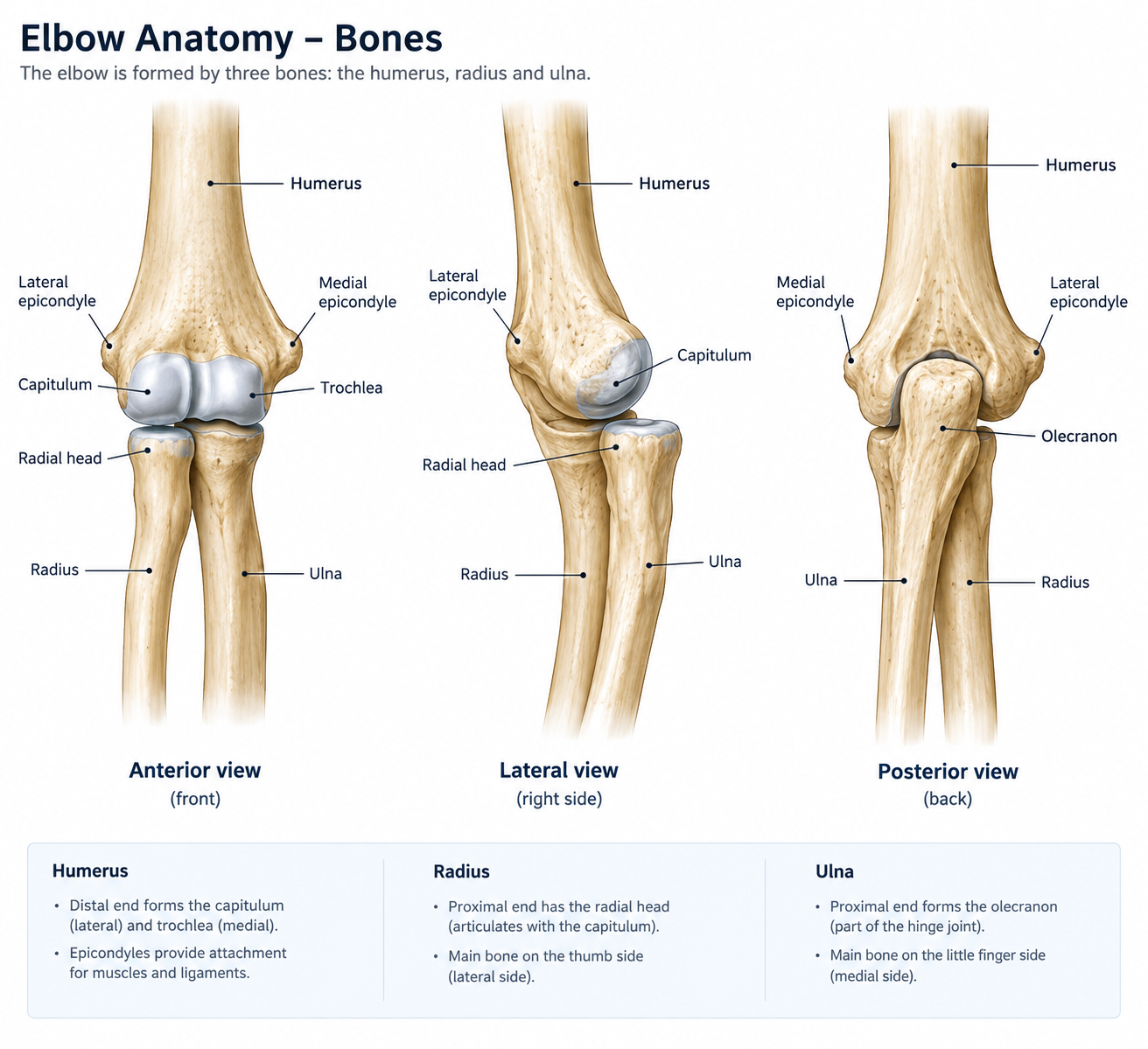
The elbow is a hinge joint formed where three bones meet — the humerus in your upper arm, and the radius and ulna in your forearm. It mostly bends and straightens, but it also allows your forearm to rotate, turning your palm up and down, which is what lets you use a screwdriver or turn a door handle. That combination of hinge and rotation is part of what makes the elbow such a versatile joint, and also part of why it takes on so much repetitive load across an average day.
Two tendon groups do a lot of the work around the elbow and are responsible for the majority of the elbow pain we see. The common extensor tendon attaches on the outside of the elbow (the lateral epicondyle) and is behind tennis elbow, while the common flexor tendon attaches on the inside (the medial epicondyle) and is behind golfer's elbow. The ulnar nerve — your ‘funny bone’ nerve — runs around the inside of the elbow and can become irritated or compressed, while a small cushioning sac called the olecranon bursa sits right at the tip of the elbow and can become inflamed with repeated pressure.
Because so many everyday and work tasks involve gripping, lifting, and repetitive forearm movement, the elbow copes with an enormous cumulative load over a normal week — often more than people realise until something starts to hurt. Understanding exactly which structure is under strain, and why, is the first step to actually fixing it rather than just managing around it.
It's also worth knowing that the wrist and hand are directly connected to a lot of what happens at the elbow, since the muscles that move your wrist and fingers originate around the elbow joint. This is exactly why elbow pain so often traces back to repetitive gripping or typing rather than anything happening at the elbow itself, and why treatment frequently looks beyond the sore spot to the whole forearm. The same logic applies in reverse too — a tight or overloaded shoulder can sometimes change how your forearm and elbow are working, which is part of why we don't assess the elbow entirely in isolation.
Common Elbow Conditions We Treat
Elbow pain can come from several different structures, and it's common for more than one to be contributing at once. Here are six of the conditions we see most often at our Erina clinic.
Tennis Elbow (Lateral Epicondylalgia)
Despite the name, most people we see with tennis elbow have never picked up a racquet. It's an overload injury to the common extensor tendon on the outside of the elbow, usually from repetitive gripping, typing, manual work, or a sudden increase in an activity that involves the wrist and forearm. It shows up as an ache or sharp pain on the outside of the elbow that's often worse with gripping, lifting with a straight arm, or simple tasks like shaking hands or lifting a kettle. Like most tendon problems, it tends to build gradually and can become surprisingly limiting before people decide to get it looked at, often because the pain is easy to dismiss as ‘just a bit sore’ in the early weeks. Once it's properly irritated, though, it can affect grip strength enough to make everyday tasks like opening jars or carrying shopping bags noticeably harder.
Learn more: Tennis Elbow (Lateral Epicondylalgia) →
Golfer's Elbow (Medial Epicondylalgia)
The mirror image of tennis elbow, golfer's elbow affects the common flexor tendon on the inside of the elbow. It's common in golfers and throwing athletes, but just as common in tradies, gardeners, and anyone doing repetitive gripping or wrist-flexing work. Pain is usually felt on the inside of the elbow, often worsened by gripping, lifting, or twisting movements, and can sometimes overlap with irritation of the nearby ulnar nerve, which occasionally adds some tingling into the mix alongside the tendon pain. Because the inside of the elbow sits close to the ulnar nerve, it's worth having a proper assessment to work out whether you're dealing with a pure tendon issue or some combined nerve irritation, since the treatment emphasis differs slightly between the two.
Learn more: Golfer's Elbow (Medial Epicondylalgia) →
Elbow Bursitis
The olecranon bursa sits right at the bony tip of the elbow, cushioning it against pressure. When it becomes inflamed — often from leaning on hard surfaces for long periods, a direct knock, or sometimes an infection — it can swell noticeably, sometimes to the size of a golf ball, and become tender or warm to touch. It looks more dramatic than it usually is, but it's still worth having assessed properly, particularly to rule out infection, which needs a different approach entirely and sometimes requires antibiotics rather than physiotherapy alone. Non-infected bursitis, on the other hand, generally responds well to simple activity modification and protecting the area from further pressure while it settles.
Learn more: Elbow Bursitis →
Cubital Tunnel Syndrome
This is where the ulnar nerve becomes compressed or irritated as it passes around the inside of the elbow, often producing tingling or numbness in the ring and little fingers rather than pain at the elbow itself. It's commonly aggravated by prolonged elbow bending, leaning on the elbow, or sleeping with the arm curled up tightly against your chest. Left unaddressed, ongoing nerve compression can lead to weakness in the hand, so this is one we like to catch and manage early rather than waiting for it to progress. Simple changes like keeping the elbow straighter at night, or adjusting a desk setup that has you resting on your elbow for hours at a time, often make a bigger difference than people expect.
Learn more: Cubital Tunnel Syndrome →
Distal Biceps Tendinopathy
The biceps tendon attaches into the forearm just below the elbow crease, and this attachment point can become irritated or, in more significant cases, torn — usually from heavy or sudden lifting, particularly with the elbow bent and the forearm twisted. It causes pain at the front of the elbow, often with weakness in bending the elbow or rotating the forearm, and a full tear can sometimes cause a visible change in the shape of the biceps muscle, occasionally described as a ‘Popeye’ deformity. A suspected full tear is one of the few elbow presentations where we'll usually recommend prompt imaging and a specialist opinion, since surgical repair is time-sensitive if that's the right path for you.
Learn more: Distal Biceps Tendinopathy →
Elbow Osteoarthritis
Less common than at the hip or knee, but still something we see, particularly in people with a history of heavy manual work, previous elbow injury, or a family history of arthritis. It causes a deep ache, stiffness, and sometimes a grinding or catching sensation with movement, and tends to flare with cold weather or after periods of heavy use. While it can't be reversed, the right management makes a genuine difference to pain, stiffness, and day-to-day function, and most people manage it well long-term with a combination of targeted strengthening, activity pacing, and flare-up management rather than needing surgical intervention.
Learn more: Elbow Osteoarthritis →
Common Elbow Symptoms
People describe elbow pain in all sorts of ways, and the specific pattern often tells us a lot before we've even begun the physical assessment. It's rarely just ‘my elbow hurts’ — it's usually a fairly specific combination of the following:
Pain on the outside or inside of the elbow that worsens with gripping, twisting, or lifting
Pain lifting objects with a straight arm, such as a kettle, a frying pan, or a bag of shopping
Tingling or numbness in the ring and little fingers, sometimes worse first thing in the morning
Swelling or a soft lump right at the tip of the elbow
Weakness in grip strength or bending the elbow, sometimes noticed as things slipping out of your hand
Stiffness or a grinding sensation with elbow movement, particularly first thing in the morning
Pain that started after a sudden increase in gripping, lifting, or racquet sport activity
A dull ache that lingers after work or training and is often worse the next morning
You don't need to know exactly which structure is involved before booking in — that's exactly what your assessment is for. But if any of the above sounds familiar, particularly if it's affecting your grip strength or has been hanging around for more than a couple of weeks, it's worth getting looked at properly rather than hoping it fades on its own.
How We Assess Elbow Pain
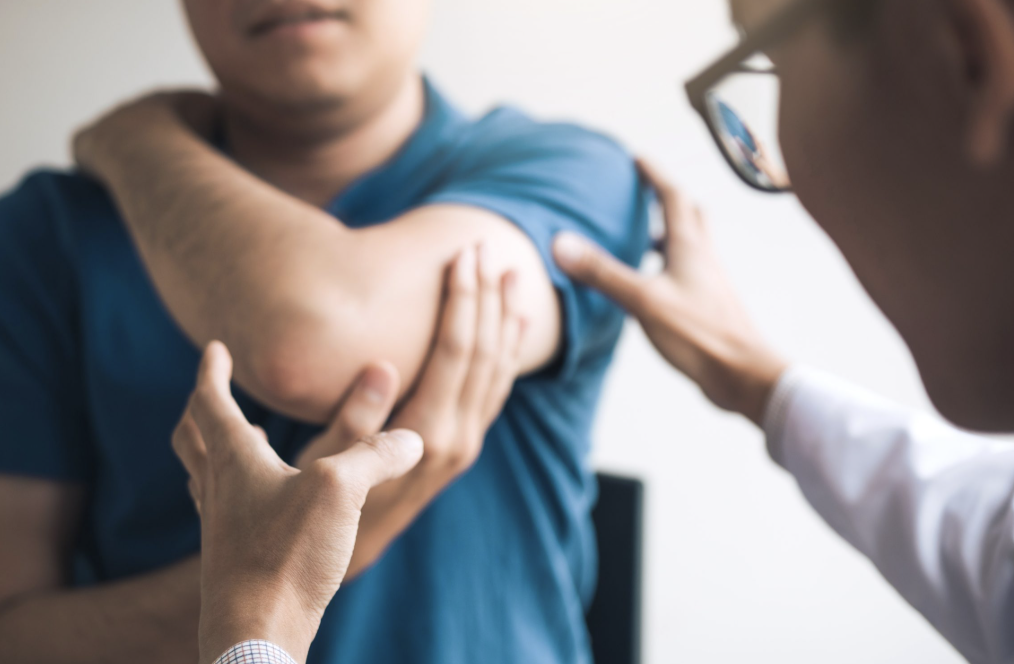
Your first appointment starts with a thorough conversation about how your pain started, what your work, sport, and daily tasks actually involve, and what's been aggravating things. That context often gives us as much information as the physical tests themselves, particularly for tendon and nerve-related conditions that build up gradually from repetitive load.
From there, we move into a hands-on assessment of your elbow's movement, grip strength, and a series of specific tests that help pinpoint exactly which tendon, nerve, or joint structure is involved. We'll also check your wrist, forearm, and neck, since problems in these areas can refer pain into the elbow or contribute to ongoing overload, and addressing only the elbow without looking upstream and downstream can leave part of the problem untreated.
In most cases, imaging isn't required — a thorough clinical assessment identifies the likely cause in the large majority of presentations, and we reserve imaging for cases that aren't progressing as expected or where the clinical picture isn't clear. If imaging or a specialist opinion is needed, we'll organise the referral and keep your GP in the loop.
By the end of your first session, you'll walk away with a working diagnosis, a clear explanation of what's driving your symptoms, and a first set of exercises or practical advice to start on straight away — not just a label for your pain and a vague instruction to rest.
How Physiotherapy Helps
Treatment is built around what's actually driving your specific pain. For tendon-related conditions like tennis and golfer's elbow, this usually means a progressive loading program designed to rebuild the tendon's tolerance, combined with activity modification while things settle. For nerve-related issues like cubital tunnel syndrome, treatment focuses on reducing compression and irritation, along with postural and positional advice, particularly around sleep and prolonged elbow bending. For bursitis, early management is about calming the inflammation and identifying what's been causing repeated pressure on the area.
Just as important as what happens in the clinic is what you do at home and at work. We'll give you a realistic exercise program and practical advice on modifying your grip, tools, or technique, since ongoing overload at work or in sport is one of the most common reasons elbow pain becomes a repeat problem rather than a one-off. For tradies and manual workers, this often means small, practical changes to grip size, tool choice, or technique that make a surprisingly large difference over time.
For racquet sport and golf players, we'll also take a look at technique and equipment where relevant, since a grip that's too small, or a swing pattern that's overloading one particular tendon, is often part of the picture alongside the rehab itself.
None of this is a quick, one-session fix. Tendons in particular need time and consistent loading to rebuild their capacity, and rushing this process is one of the most common reasons elbow pain becomes a repeat visitor rather than something that resolves properly. We'll be upfront with you about roughly how many sessions we expect you'll need and what progress should look like along the way.
Elbow Recovery Timeframes
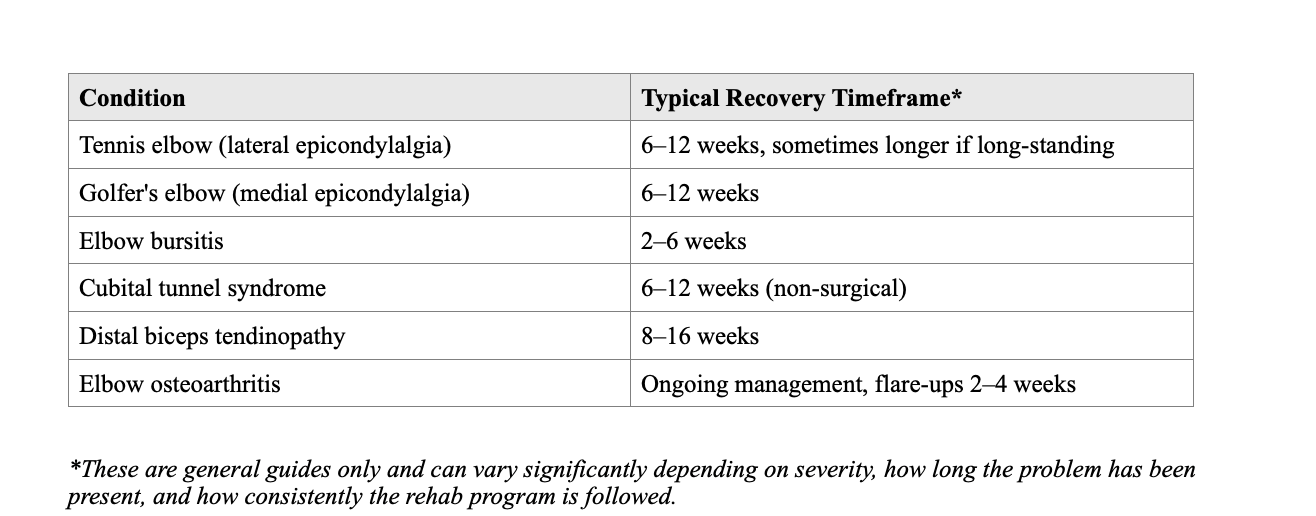
Every elbow is different, but these general ranges give you a rough idea of what to expect. Your physiotherapist will give you a more accurate timeframe once we understand your specific diagnosis.
Why Choose Thrive Physiotherapy
We're a local team based right here in Erina, and elbow pain is one of the conditions we treat most often — from tradies who need their grip strength back on the tools, to weekend tennis players keen to get back on the court without wincing on every backhand. We explain what's actually going on in plain language and build a plan around your goals, not a generic handout.
Whether your elbow pain is brand new or something you've been managing around for months, our approach stays the same: a proper assessment, an honest explanation, and a plan that's realistic for your work and your week — not just an idealised version of it. If something isn't improving the way we expected, we'll say so and adjust the plan rather than quietly continuing on regardless.
Preventing Elbow Pain From Coming Back
Once your elbow has settled, the priority shifts to making sure it stays that way. For tendon-related conditions in particular, this usually means maintaining a baseline level of grip and forearm strength even after symptoms resolve, since tendons that drop back below their working capacity are more vulnerable to flaring up again under the same load that caused the original problem.
For tradies and manual workers, small practical changes often matter more than people expect — alternating tasks to avoid hours of repetitive gripping, using a slightly larger tool handle, or taking short breaks during particularly demanding jobs. For racquet sport and golf players, keeping up a simple maintenance program through the season, rather than only doing rehab exercises when something already hurts, is one of the more effective ways to keep tendon issues from becoming a recurring pattern.
We'll talk you through exactly what this looks like for your specific situation before you finish your course of treatment, so you're not left guessing about what to keep doing once the regular sessions wrap up.
Frequently Asked Questions
Do I need a referral to see a physiotherapist for elbow pain?
No, you can book directly with us. If you're being treated under a specific plan such as an EPC or WorkCover claim, bring any paperwork along and we'll help you sort out the details.
Will I need a scan for my elbow pain?
Usually not. Most elbow conditions can be diagnosed clinically, and imaging is reserved for cases where it's likely to change the treatment plan or where recovery isn't progressing as expected.
Can I keep working or playing sport while my elbow heals?
In most cases, yes, with some modification. We'll help you identify which specific movements to adjust rather than telling you to stop everything.
Is a brace or strap helpful for tennis or golfer's elbow?
A counterforce brace can help some people manage symptoms during aggravating activities, though it's a support tool rather than a substitute for addressing the underlying tendon loading issue.
How many sessions will I need?
It depends on the condition and how long it's been present. Some elbows settle in a handful of sessions with a home program; others, particularly long-standing tendon issues, need a longer-term plan. We'll give you an honest estimate after your first visit.
Why does my elbow hurt more the morning after work or training?
Tendons often react with a delayed flare rather than pain during the activity itself, so soreness the next morning is a very typical pattern for tendon overload rather than a sign something new has gone wrong.
Can elbow pain be related to my neck or shoulder?
Occasionally, yes. Nerve irritation from the neck can sometimes mimic or contribute to elbow and forearm symptoms, and shoulder mechanics can indirectly increase load through the elbow during overhead or throwing activities, which is why we look at the whole arm rather than just the sore spot.
Should I stretch or strengthen a sore elbow?
Both have a place, but strengthening through a gradual, well-dosed loading program tends to matter more for genuine tendon recovery than stretching alone. We'll show you exactly what to prioritise based on your specific diagnosis.
Book Your Elbow Assessment
If elbow pain is affecting your grip, your work, or your sport, don't wait for it to get worse. The longer it's left, the more it tends to affect grip strength and everyday function, which can make recovery slower than it needed to be.
Book an appointment with our Erina team and let's work out exactly what's going on — and what to do about it.