

Shoulder pain has a way of creeping into everything. Reaching for a top shelf, clipping in a seatbelt, sleeping on your side, even just lifting your arm to wash your hair — when your shoulder isn't working properly, it affects almost every part of your day. It's rarely just a fitness problem or a work problem; it's usually both, plus your sleep, plus your mood by about week three.
At Thrive Physiotherapy in Erina, we see shoulder pain in tradies who can't get their arm above their head by 10am, weekend surfers whose paddling has gone from effortless to painful, gym-goers whose bench press has quietly stalled, office workers who didn't notice their posture until the ache started, and grandparents who just want to pick up their grandkids without wincing. The stories are all different, but the process for working it out is remarkably consistent.
Whatever brought you here, the goal is the same: identify what's actually going on — not just ‘shoulder pain’ as a vague label — and build a plan around it. That usually means a clear diagnosis, an honest timeframe, and a program that fits into your actual life rather than an idealised one where you have an hour to spare every day.
Some shoulders need a few sessions of hands-on treatment and a bit of guidance to get back on track. Others need a longer, more structured process, particularly if there's been an injury, a long-standing niggle that's been ignored, or a condition like frozen shoulder that simply takes time to resolve. Either way, you'll leave your first appointment with a clear idea of what's going on and what the plan looks like from here — not a vague ‘come back if it doesn't improve’.
Understanding Your Shoulder
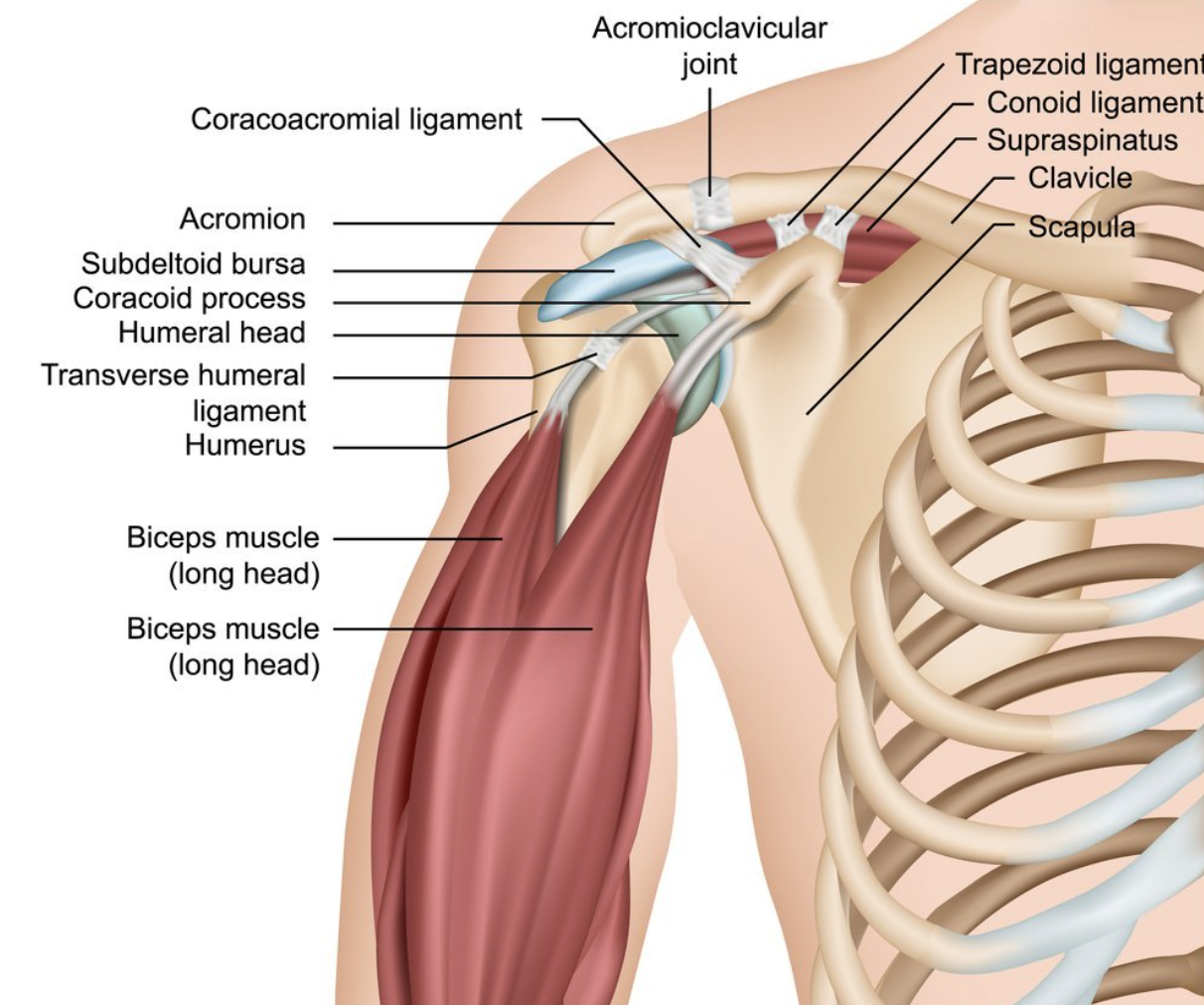
The shoulder is the most mobile joint in the body, which is exactly why it's also one of the most prone to injury. Unlike the hip, which sits in a deep, stable socket, the shoulder joint is more like a golf ball balanced on a tee — a large ball sitting on a relatively shallow socket. That design gives you an enormous range of movement, letting you reach behind your back, throw a ball, or lift your arm overhead in almost any direction.
The trade-off is stability. To keep the joint together and controlled through that huge range, the shoulder relies heavily on soft tissue: a group of four muscles and tendons known as the rotator cuff, a cushioning sac called the bursa that helps tendons glide smoothly, and a ring of cartilage called the labrum that deepens the socket slightly. When any one of these structures is overloaded, injured, or simply stops doing its job properly, the whole system tends to compensate — which is often how a small niggle turns into a persistent problem.
Shoulder Physiotherapy Erina & Central Coast
Common Shoulder Conditions We Treat
Shoulder pain can come from several different structures, and it's common for more than one to be involved at once. Here are six of the conditions we see most often at our Erina clinic.
Rotator Cuff Tendinopathy
This is one of the most common causes of shoulder pain we see, particularly in people who do a lot of overhead work, lifting, or repetitive gym pressing. The tendons of the rotator cuff become irritated and gradually lose their normal tolerance to load, which usually shows up as a deep ache on the outside of the shoulder that worsens with lifting, reaching overhead, or sleeping on that side. It tends to build gradually rather than appear overnight — a bit more soreness after training, a bit less range each week — which is exactly why it's easy to ignore until it's genuinely limiting you. Left untreated, it tends to hang around and slowly narrow down what you're comfortable doing, and can eventually lead to compensation patterns in the neck and upper back as you unconsciously avoid using the arm normally. The good news is that tendons respond well to the right kind of progressive loading, so this is one of the more predictable conditions to work with once we know exactly how irritable it currently is.
Learn more: Rotator Cuff Tendinopathy →
Frozen Shoulder
Frozen shoulder (adhesive capsulitis) is a genuinely frustrating condition to go through, and one of the ones patients ask us the most questions about. The shoulder capsule tightens and thickens, and movement becomes progressively more restricted — often alongside a deep, nagging pain that's worse at night and can seriously disturb sleep. It tends to move through recognisable stages: a painful ‘freezing’ phase, a stiffer but less painful ‘frozen’ phase, and a gradual ‘thawing’ phase where movement slowly returns. Left alone, the whole process can take well over a year, and sometimes longer in people with diabetes, who tend to be more prone to it. Physiotherapy won't necessarily fast-track every stage, but it makes a genuine difference to pain levels, sleep, and how much day-to-day function you keep along the way — and it helps you understand which stage you're actually in, which takes a lot of the anxiety out of an otherwise confusing condition.
Learn more: Frozen Shoulder →
Shoulder Impingement
Impingement happens when the rotator cuff tendons get pinched under the bony arch at the top of the shoulder during overhead movement. It's common in swimmers, painters, tradies working above shoulder height, and gym-goers who've ramped up their overhead pressing. The pain often has a fairly recognisable pattern — comfortable at rest, then a sharp catch or ache somewhere in the middle of lifting the arm out to the side, sometimes easing again once the arm is fully overhead. Poor shoulder blade control and tightness through the upper back are common contributing factors, which is why treatment usually looks beyond just the sore spot to the way the whole shoulder girdle is moving. Left unaddressed, ongoing impingement can gradually irritate the rotator cuff tendons and bursa underneath it, which is part of why early treatment tends to be more straightforward than treatment further down the track.
Learn more: Shoulder Impingement →
Shoulder Bursitis
The bursa is a small fluid-filled sac that sits between the rotator cuff tendons and the bone above, helping everything glide smoothly as you move your arm. When it becomes inflamed, movement can become sharp, guarded and unpredictable, and the shoulder often feels tender to touch or genuinely painful to lie on at night. Bursitis frequently develops alongside impingement or rotator cuff tendinopathy rather than as a standalone problem, so part of our job is working out whether the bursa is the main issue or a symptom of something else going on nearby, such as an overloaded tendon that's driving the inflammation in the first place. Settling the irritability down early usually makes the rest of the rehab process considerably smoother.
Learn more: Shoulder Bursitis →
AC Joint Injury
The acromioclavicular (AC) joint sits at the very top of the shoulder, where the collarbone meets the shoulder blade. It's commonly injured through a direct fall onto the point of the shoulder — a mountain bike stack or a hard tackle on the footy field are classic causes — or gradually through heavy bench pressing and dips. Pain is usually well localised to that bony bump on top of the shoulder, tender to press on, and often noticeably worse with movements that bring the arm across the body, like reaching for a seatbelt or doing up a top button behind your back. Depending on the grade of injury, management ranges from a short period of protection and gradual loading through to a longer, more structured rehab plan, and in higher-grade injuries, a discussion with a specialist about whether surgery is warranted.
Learn more: AC Joint Injury →
Shoulder Instability
Some shoulders simply move more than they're meant to. Whether it's from a traumatic dislocation, a partial subluxation, or naturally looser ligaments that have been there your whole life, instability can leave the shoulder feeling like it's about to ‘give way’ — particularly overhead, out to the side, or in the classic ‘arm cocked back’ throwing position. It's more common in younger, active patients and contact sport athletes, and the right rehab approach depends heavily on how the instability first developed and how many times it's happened before. Building genuine strength and control around the joint is usually the priority, whether or not surgery is also part of the picture, since the surrounding muscles play a huge role in how stable the joint feels day to day, on top of whatever the underlying anatomy is doing.
Learn more: Shoulder Instability →
Common Shoulder Symptoms
People come to us describing shoulder pain in all sorts of ways, and the pattern of symptoms often gives us useful clues before we've even started the physical assessment. It's rarely just ‘my shoulder hurts’ — it's more often a specific combination of the following:
Pain when lifting your arm out to the side or overhead, particularly through a specific arc of movement
Pain that wakes you at night or makes it hard to sleep on that side, even with a pillow tucked under the arm
A catching, clicking or grinding feeling with certain movements, sometimes with a brief sharp twinge
Weakness when lifting, carrying or reaching, especially above shoulder height or when your arm is out in front of you
Stiffness that makes everyday tasks like putting on a jacket, reaching for a seatbelt, or doing up a bra clasp behind your back genuinely difficult
A feeling of instability, or that the shoulder might ‘pop’ or ‘give way’ under load
Pain that started after a fall, a heavy gym session, or a sudden increase in overhead activity like painting or renovating
A dull ache that's hard to pinpoint but never quite goes away, even on days you haven't done anything unusual
You don't need to know which structure is involved before you come in — that's exactly what the assessment is for. But if any of the above sounds familiar, particularly if it's been going on for more than a couple of weeks or is starting to change how you move, sleep or train, it's worth getting it looked at rather than hoping it quietly settles on its own.
Shoulder pain doesn't usually appear out of nowhere, even when it feels that way. It's often the end result of repetitive overhead movement, a sudden change in training load, months of poor sleeping posture, a fall onto an outstretched arm, or the joint simply stiffening up over time without you noticing. Understanding which structure is involved, and why it's under strain, is the first step to actually fixing it — which is exactly what a proper assessment is for.
It's also worth saying that the same movement, or the same MRI finding, can mean very different things in different people. Two patients can have almost identical scan results and completely different levels of pain and function — which is exactly why we treat the person in front of us, not just the report. This is also why a hands-on assessment matters so much: it tells us how your shoulder is actually behaving, not just what it looks like on paper.
How We Assess Shoulder Pain
Your first appointment starts with a thorough conversation, not a rushed five-minute chat. We want to know how the pain started, what makes it better or worse, what your work and training actually involve day to day, and what you're hoping to get back to — whether that's playing with your kids, getting back on the tools, or returning to competitive sport. That context matters just as much as the physical findings.
From there, we move into a hands-on assessment of your shoulder's range of movement, strength across each part of the rotator cuff, and a series of specific orthopaedic tests that help narrow down which structures are involved and how irritable they currently are. We'll also look at your neck, shoulder blade control, and posture, since problems in those areas often feed into shoulder pain even when the shoulder itself is where you feel it.
In most cases, imaging isn't needed straight away. A thorough clinical assessment can identify the likely source of your pain in the large majority of cases, and imaging is reserved for situations where it will genuinely change the treatment plan, where recovery isn't progressing as expected, or where there are signs that warrant a closer look. If imaging or a specialist opinion is needed, we'll organise the referral and keep your GP in the loop throughout.
By the end of your first session, you'll have a working diagnosis, a clear explanation of what's driving your symptoms, and a first set of exercises or advice to start on straight away. We'd rather you leave with something practical to do than just a name for your pain.

How Physiotherapy Helps
Treatment is built around what's actually driving your pain, not a generic protocol applied to every shoulder that walks through the door. Depending on your diagnosis, this might include hands-on treatment to ease pain and restore movement, a graded loading program designed to rebuild the strength and tolerance of the rotator cuff, and postural or technique adjustments if training habits, work setup, or sleeping position are contributing to the problem.
Just as important is what you do between sessions. We'll give you a home exercise program that's realistic for your schedule — not a laminated sheet with fifteen exercises you'll never get through — and we'll adjust it as you progress. There's no benefit in doing the same three exercises for three months once your shoulder is ready for more. For sport or gym-related shoulder pain, we'll also work out how to keep you training in some capacity while things settle, rather than simply telling you to stop everything and wait it out.
For more persistent or complex presentations, such as long-standing frozen shoulder or recurrent instability, we'll also talk openly with you about realistic timeframes and, where relevant, coordinate with your GP or a specialist so everyone involved in your care is working from the same picture.
None of this works as a one-off fix. Shoulders that have been sore for a while, or that are being asked to cope with heavy manual work or repetitive sport, generally need a structured block of care rather than a single treatment. We'll always be upfront about roughly how many sessions we think you'll need and what progress should look like along the way, so you're never left wondering whether it's working.
We also keep a close eye on the things that get missed elsewhere — how your neck is moving, whether your shoulder blade is doing its share of the work, and whether pain from one side has started to change how you're using the other. Shoulders rarely operate in isolation, and treating the whole picture is usually what separates a quick fix from a lasting one.
Shoulder Recovery Timeframes
Every shoulder is different, but these general ranges give you a rough idea of what to expect. Your physiotherapist will give you a more accurate timeframe once we understand your specific diagnosis.
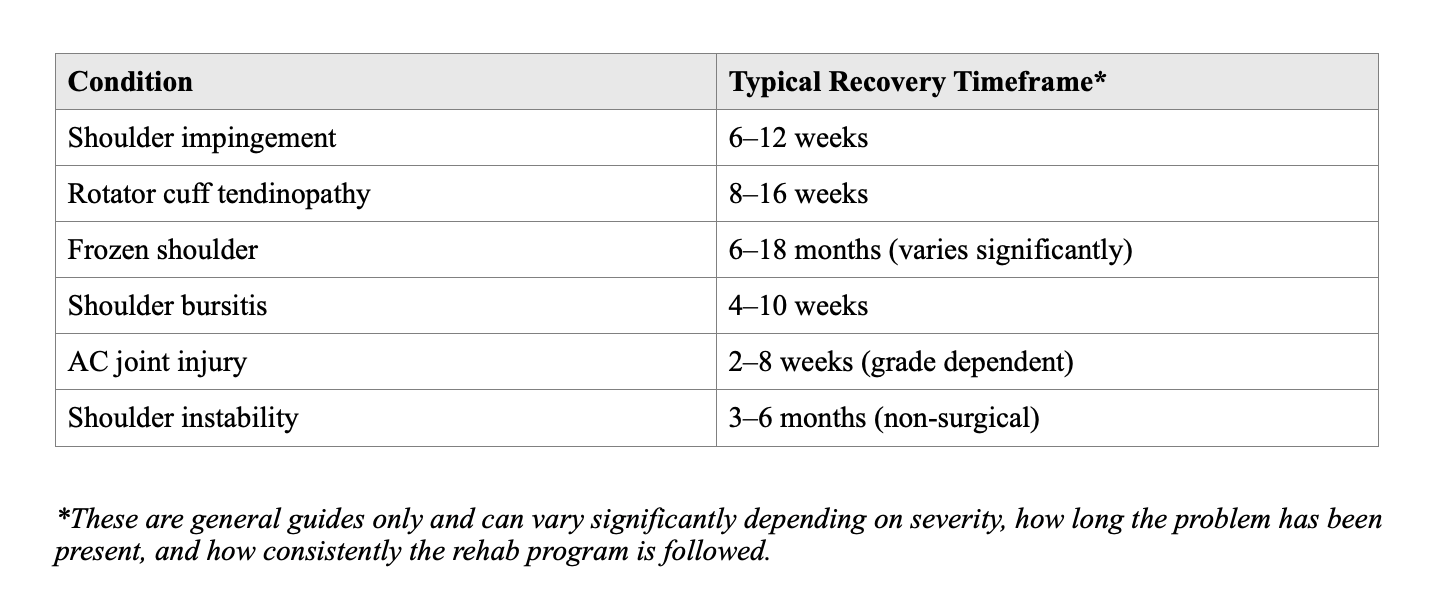
If your recovery looks like it's tracking outside these ranges — either much faster or much slower — that's useful information too, and something we'll factor into your ongoing plan rather than just sticking to a generic timeline.
Frequently Asked Questions
Do I need a referral to see a physiotherapist for shoulder pain?
No, you can book directly with us without seeing your GP first. If you're being treated under a specific plan such as an EPC or WorkCover claim, or if imaging has already been done elsewhere, bring that information along and we can talk you through what paperwork is needed.
Will I need a scan before I can be treated?
Usually not. Most shoulder conditions can be diagnosed clinically through a thorough history and physical assessment, and we'll only recommend imaging if it's likely to change your management, if you're not progressing as expected, or if something doesn't fit the usual pattern.
Can I keep training or working while my shoulder heals?
In most cases, yes — with some modification. Complete rest is rarely the answer for shoulder pain, and staying appropriately active, within limits we help you define, usually leads to a faster and more complete recovery than stopping altogether.
How many sessions will I need?
It depends entirely on the condition and how long it's been going on. Some shoulders settle in a handful of sessions with a home program to follow; others, like frozen shoulder or long-standing instability, need a longer-term plan spread over several months. We'll give you an honest estimate after your first visit, and update it as we see how you respond.
What if my shoulder pain has been going on for months, or even years?
That's still very treatable. Long-standing shoulder pain often responds well once the right diagnosis and loading plan are in place — it just may take a bit longer than a recent injury, and we'll be upfront with you about that from the start.
Should I rest completely or keep moving my shoulder?
Almost always, some movement is better than none. Complete rest tends to make shoulders stiffer and slower to recover, whereas the right amount and type of movement — guided by your assessment — usually speeds things up. We'll be specific about what to avoid and what's safe to keep doing.
I've had a cortisone injection — can I still see a physio?
Yes, and it's often a good combination. An injection can reduce pain enough to make rehab more comfortable, but it doesn't address the underlying strength or movement issues, which is where physiotherapy comes in.
Is shoulder physiotherapy covered by Medicare or WorkCover?
If your shoulder injury is work-related, it may be covered under a WorkCover claim, and we can guide you through that process. For eligible patients with a chronic condition, a GP-issued Enhanced Primary Care (EPC) plan can also provide a Medicare rebate for a set number of sessions. Bring any paperwork you have to your first visit and we'll help you sort out the details.
Why Choose Thrive Physiotherapy
We're a local team based right here in Erina, and a lot of our shoulder patients come to us through word of mouth from someone we've already helped get back to surfing, gardening, work, or just sleeping through the night without pain. We take the time to actually explain what's going on with your shoulder in plain language, not jargon, and we'll never keep you coming back for sessions you don't need.
Whether your shoulder pain is brand new or something you've been putting up with for years, our approach is the same: a proper assessment, an honest explanation, and a plan built around your goals — not a generic handout. If something isn't improving the way we expected, we'll say so and adjust the plan rather than quietly continuing on regardless.
Book Your Shoulder Assessment
If shoulder pain is getting in the way of your training, your work or your sleep, don't wait for it to get worse. The longer a shoulder problem is left unaddressed, the more it tends to affect the muscles and movement patterns around it, which can make recovery slower than it needed to be.
Book an appointment with our Erina team and let's work out exactly what's going on — and what to do about it.
Call Thrive Physiotherapy or book online today.