

Low back pain has a way of shrinking your world without you quite noticing it happen. You stop bending to tie your shoes without thinking about it first. You start choosing chairs based on how supportive they look. You catch yourself avoiding the drive to the shops because sitting in the car doesn't feel worth it. It rarely announces itself as a big dramatic injury — more often it's a gradual erosion of things you used to do without a second thought.
At Thrive Physiotherapy in Erina, we see low back pain in tradies who've tweaked something lifting on site, parents who've bent the wrong way picking up a toddler, office workers whose backs have quietly stiffened up over years at a desk, weekend gardeners, and older patients managing a back that's simply changed with age. Whatever brought you in, the goal is the same: work out exactly what's driving your pain, and build a realistic plan around it.
Low back pain is also one of the most over-catastrophised areas of the body. Scans often show findings that sound alarming but are extremely common in people with no pain at all, and most low back pain — including sciatica — improves significantly with the right guidance and doesn't need surgery. Getting an accurate, honest picture of what's actually going on is often half the battle.
Some backs need a handful of sessions and a solid strengthening program to get back on track. Others, particularly nerve-related presentations or longer-standing pain, need a more structured, longer-term process. Either way, you'll leave your first appointment with a clear working diagnosis and a genuine plan, not just a name for your pain and a vague instruction to rest.
Lumbar Spine (Lower Back) Physiotherapy Erina & Central Coast
Understanding Your Lumbar Spine
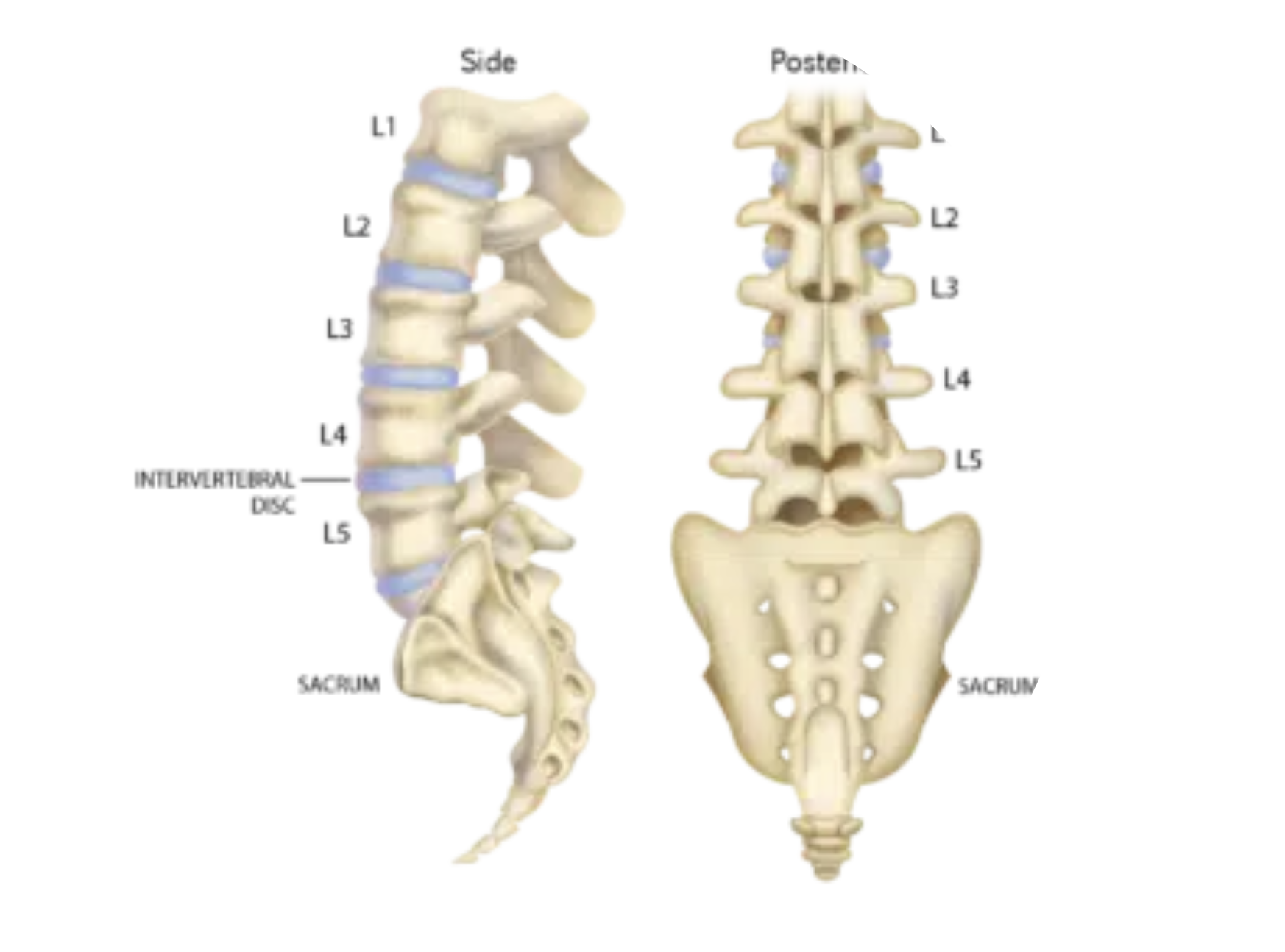
Your lumbar spine is made up of five vertebrae (L1 to L5) stacked on top of your sacrum, with a cushioning disc between each level acting as a shock absorber. Behind each disc sit a pair of facet joints, small joints that guide and limit how far your spine can bend, extend, and rotate. Nerves exit the spine at each level and travel down into your legs, which is why problems in the lower back can sometimes cause symptoms felt well away from the spine itself, such as pain, numbness, or tingling down the leg. Below the lumbar spine sit the sacroiliac (SIJ) joints, where your spine connects to your pelvis on either side. These joints don't move much, but they play an important role in transferring load between your upper body and legs, and can become a genuine source of pain in their own right, particularly around pregnancy, after a fall, or with repetitive asymmetrical loading.
Common Lumbar Spine Conditions We Treat
Low back pain can come from several different structures, and it's common for more than one to be contributing at once. Here are six of the conditions we see most often at our Erina clinic.
Non-Specific Low Back Pain
This is the most common type of back pain we see — pain without one single, clearly identifiable structural cause, usually related to a combination of muscle guarding, joint stiffness, and reduced load tolerance rather than any one damaged structure. It often follows a lifting injury, an awkward movement, or simply builds up gradually from a mix of prolonged sitting, deconditioning, and life stress. Despite the name sounding vague, it responds very well to the right movement-based treatment, and most people are surprised at how quickly a proper, structured approach makes a difference once the fear of movement is addressed alongside the physical symptoms.
Learn more: Non-Specific Low Back Pain →
Sciatica & Disc Herniation
Sciatica describes pain, numbness, or tingling that travels down the leg, usually caused by irritation or compression of a nerve root in the lower back — often related to a disc herniation pressing on or chemically irritating the nerve. It can range from a mild, intermittent ache to significant leg pain that outweighs the back pain itself, and can sometimes be genuinely disruptive to sleep and daily function in the acute stage. The good news is that the large majority of disc-related sciatica improves substantially with time and the right conservative management, and surgery is only needed in a small minority of cases.
Learn more: Sciatica & Disc Herniation →
Facet Joint Pain
The small facet joints that guide movement at each level of your spine can become irritated or inflamed, often from repetitive extension or rotation, or following a specific awkward movement like reaching up into a cupboard or twisting while lifting. Facet joint pain tends to be felt close to the spine, often worse with arching backward or twisting, and can sometimes refer pain into the buttock or upper thigh, which occasionally leads to confusion with sciatica even though the underlying mechanism is quite different.
Learn more: Facet Joint Pain →
Spinal Stenosis
Stenosis describes a narrowing of the space around the spinal nerves, most commonly related to age-related changes in the discs, joints, and ligaments of the spine. It classically causes leg pain, heaviness, or cramping that worsens with walking or standing and eases with sitting or bending forward — a pattern that's often distinctive enough to help confirm the diagnosis on its own. It's more common in older adults, and while it can't be reversed, it can usually be managed very effectively without surgery through targeted exercise and activity strategies.
Learn more: Spinal Stenosis →
Spondylolisthesis
This occurs when one vertebra slips forward relative to the one below it, sometimes related to a stress fracture in a younger, active spine — common in gymnasts, fast bowlers, and dancers — and sometimes a gradual degenerative change in an older spine. Symptoms vary widely from no pain at all to significant low back pain, sometimes with associated leg symptoms if a nerve becomes involved. Many cases are managed very successfully with targeted strengthening rather than surgery, particularly when caught and rehabilitated appropriately.
Learn more: Spondylolisthesis →
SIJ Dysfunction
The sacroiliac joints connect your spine to your pelvis, and pain here is often felt as a deep ache on one side of the lower back, close to the dimple above your buttock, sometimes radiating into the buttock or upper thigh. It's common during and after pregnancy, following a fall onto the buttock, or with repetitive asymmetrical loading such as always carrying a child on one hip or favouring one leg during sport. It's frequently confused with general low back pain or even hip pain, which is part of why an accurate diagnosis matters so much for getting the right treatment underway.
Learn more: SIJ Dysfunction →
Common Lumbar Spine Symptoms
People describe low back pain in all sorts of ways, and the specific pattern of symptoms often gives us useful clues before we've even started the physical assessment. It's rarely just ‘my back hurts’ — it's usually a fairly specific combination of the following:
A dull ache or sharp pain in the lower back, sometimes worse with specific movements
Pain, numbness, or tingling travelling down one leg, sometimes past the knee
Stiffness that's worse first thing in the morning or after sitting for a while
Pain that's worse with bending forward, arching backward, or twisting
Leg heaviness or cramping that worsens with walking and eases with sitting
A deep, one-sided ache near the dimple above the buttock
Pain that started after lifting, a fall, or a sudden awkward movement
Difficulty finding a comfortable position to sleep in
Pain that's noticeably worse with coughing, sneezing, or straining
You don't need to know exactly which structure is involved before booking in — that's exactly what your assessment is for. But if any of the above sounds familiar, particularly if you're noticing leg symptoms alongside your back pain, it's worth getting a proper assessment rather than just waiting to see what happens.
The lower back is supported by a deep layer of stabilising muscles, including multifidus, along with the larger, more familiar muscles like the erector spinae and your broader core and glute muscles. Weakness, poor coordination, or simple deconditioning in these supporting muscles is a common contributor to ongoing back pain, which is part of why a properly designed strengthening program is such a central part of most treatment plans.
It's worth saying clearly: the lumbar spine is a genuinely strong, resilient structure, built to bend, lift, and rotate thousands of times a day for decades. Persistent pain doesn't usually mean something fragile or damaged beyond repair — far more often it reflects a system that's become sensitised, deconditioned, or simply hasn't had the right rehab yet.
This distinction matters clinically as much as it matters for peace of mind. A back that's sore because it's deconditioned and guarded needs a very different approach to one with a genuine nerve compression, and part of our job in your first session is working out which situation you're actually in, rather than assuming the worst from a scan report or a well-meaning friend's story about their own back surgery.
How We Assess Lower Back Pain
Your first appointment starts with a thorough conversation about how your pain started, what makes it better or worse, and what it's stopping you from doing. We'll also ask specific screening questions to rule out anything that needs more urgent medical attention, which is standard practice for any back pain assessment and nothing to be concerned about — it's simply good, thorough clinical practice.
From there, we move into a hands-on assessment of your spine's movement, strength, and specific neurological tests if there's any suggestion of nerve involvement, such as leg symptoms. This helps us build an accurate picture of which structures are likely contributing to your pain and how irritable things currently are, which shapes exactly how we approach the early stages of your treatment.
In most cases, imaging isn't needed. The vast majority of low back pain can be assessed and managed clinically, and imaging findings often don't correlate well with pain — disc bulges and degenerative changes are extremely common in people with no back pain at all. We reserve imaging for cases with red flag features, significant or progressive neurological symptoms, or when recovery isn't progressing as expected.
By the end of your first session, you'll have a working diagnosis, a clear explanation of what's likely driving your symptoms, and a first set of exercises or advice to start on straight away — not just a name for your pain and a vague instruction to rest and see how it goes.
How Physiotherapy Helps
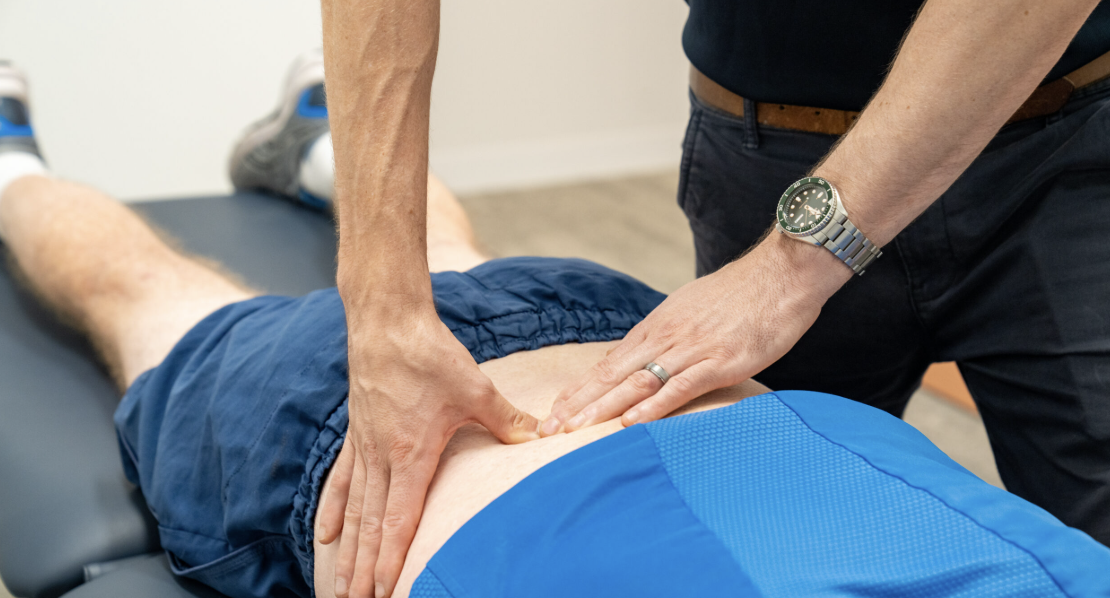
Treatment is built around what's actually driving your pain, not a generic ‘back pain protocol’. This typically includes hands-on treatment to ease pain and improve movement in the early stages, combined with a progressive strengthening program targeting your deep core, glutes, and spinal stabilisers. For nerve-related pain like sciatica, we'll also use specific techniques to reduce nerve irritation and guide safe movement while things settle.
Education is a genuinely important part of treatment for the lower back, since fear of movement and unnecessary activity avoidance are two of the most common reasons back pain becomes prolonged. We'll help you understand what's safe, what to expect, and how to stay as active as possible throughout your recovery, since movement is almost always part of the solution rather than something to avoid.
For more persistent or complex presentations, such as spinal stenosis or spondylolisthesis, we'll build a longer-term management plan and, where appropriate, coordinate with your GP or a specialist so everyone involved in your care is working from the same picture. None of this works as a single quick fix — spines that have been sore for a while generally need a properly structured block of care, and we'll be upfront with you from the start about roughly how many sessions we expect that to take.
We'll also keep a close eye on the things that get missed elsewhere — how your hips and thoracic spine are moving, whether your glutes are doing their share of the work, and whether pain has started to change how you're moving more broadly. Backs rarely operate in isolation, and treating the whole picture is usually what separates a quick fix from a lasting one.
Lumbar Spine Recovery Timeframes
Every back is different, but these general ranges give you a rough idea of what to expect. Your physiotherapist will give you a more accurate timeframe once we understand your specific diagnosis.
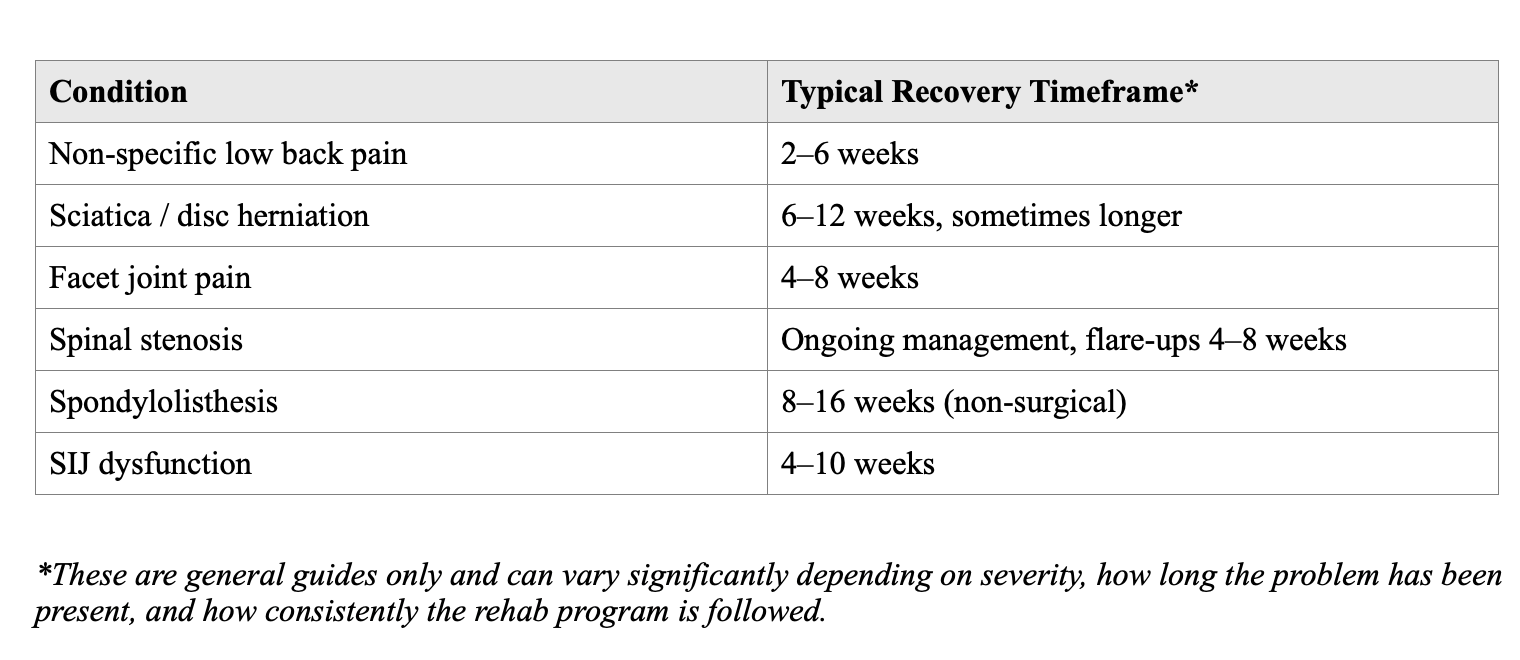
If your recovery looks like it's tracking outside these ranges — either much faster or much slower — that's useful information too, and something we'll factor into your ongoing plan rather than sticking rigidly to a generic timeline.
Preventing Back Pain From Coming Back
Once your back has settled, the priority shifts to keeping it that way. Ongoing strength in your core, glutes, and spinal stabilisers is one of the best-supported ways to reduce the risk of a repeat flare-up, along with staying generally active rather than falling back into long periods of sitting or inactivity.
For manual workers, small practical changes to lifting technique, task rotation, and pacing heavier jobs across the day can make a genuine difference over months and years of cumulative load. For desk-based workers, regular movement breaks and attention to workstation setup matter more than most people expect, particularly for backs that have been sensitised by a previous episode of pain.
We'll talk you through exactly what an ongoing maintenance plan looks like for your specific back and lifestyle before you finish your course of treatment, so you're not left guessing about what to keep doing once regular sessions wrap up.
Why Choose Thrive Physiotherapy
We're a local team based right here in Erina, and low back pain is one of the conditions we treat most often. We take the time to explain what's actually going on with your back in plain language, correct the myths that so often make back pain feel scarier than it needs to be, and build a plan around your goals rather than a generic handout.
Whether your back pain is brand new or something you've been managing around for years, our approach stays the same: a proper assessment, an honest explanation, and a plan that's realistic for your life — not just an idealised version of it. If something isn't improving the way we expected, we'll say so and adjust the plan rather than quietly continuing on regardless.
Frequently Asked Questions
Do I need a referral to see a physiotherapist for back pain?
No, you can book directly with us. If you're being treated under a specific plan such as an EPC or WorkCover claim, bring any paperwork along and we'll help you sort out the details.
Will I need a scan for my back pain?
Usually not. Most low back pain can be diagnosed and managed clinically, and imaging is reserved for cases with specific red flag features or where recovery isn't progressing as expected.
I've been told I have a bulging disc — does that mean I need surgery?
Not necessarily, and often not at all. Disc bulges are extremely common, including in people with no pain, and the large majority of disc-related pain improves significantly with conservative management.
Should I rest or keep moving with back pain?
In almost all cases, staying appropriately active is better than resting completely. Extended bed rest tends to slow recovery and increase stiffness, whereas guided movement generally speeds things up.
How many sessions will I need?
It depends entirely on the condition and how long it's been going on. Some backs settle in a handful of sessions; others, particularly nerve-related or long-standing presentations, need a longer-term plan. We'll give you an honest estimate after your first visit.
Is it normal for sciatica to take a while to improve?
Yes, nerve-related pain often takes longer to settle than muscular or joint pain, sometimes several months, even when it's clearly heading in the right direction. We'll help you understand what a normal recovery trajectory looks like for your specific presentation.
Can back pain be related to my hip or pelvis?
Yes, sometimes. SIJ dysfunction and hip conditions can both mimic or contribute to lower back symptoms, which is part of why we assess the whole region rather than just the spine in isolation.
What if my back pain has been going on for years?
Long-standing back pain is still very treatable. It often responds well once the right diagnosis and strengthening plan are in place, though it may take a bit longer to settle than a recent injury, and we'll be upfront with you about that from the start.
Book Your Lumbar Spine Assessment
If low back pain is getting in the way of work, sleep, or the things you enjoy, don't wait for it to get worse. The longer it's left unaddressed, particularly with any nerve involvement, the more it tends to affect strength and confidence in movement, which can make recovery slower than it needed to be.
Book an appointment with our Erina team and let's work out exactly what's going on — and what to do about it. Most people are relieved to finally have a clear explanation, rather than continuing to guess at what's wrong and hoping it settles on its own.