

Knee pain has a way of turning ordinary movements into calculated decisions. Stairs become something you plan for rather than climb without thinking. Kneeling in the garden gets weighed up against how sore you'll be afterward. A run that used to clear your head starts finishing with an ache that lingers into the next day. It's one of the most common reasons people come to see us, and for good reason — the knee takes on an enormous amount of load, and it doesn't take much for that load to outpace what a particular structure can currently handle.
At Thrive Physiotherapy in Erina, we see knee pain in runners building up for their next event, weekend footballers and netballers who've felt a twist or a pop, tradies and gardeners whose knees have taken years of kneeling and squatting, older patients whose knees have simply changed with age, and teenagers going through a growth spurt with knee pain that's worrying their parents more than it's worrying them. Whatever brought you in, the approach is the same: work out exactly which structure is under strain, and build a realistic plan around it.
The knee is a remarkably resilient joint, built to bend, straighten, and absorb load through millions of steps over a lifetime. Persistent knee pain doesn't usually mean something is fundamentally broken — far more often it reflects a specific structure that's become overloaded, irritated, or under-strengthened, and that responds very well once we identify exactly what's going on.
Some knees need a handful of sessions and a well-targeted loading program to settle. Others, particularly ligament injuries, meniscus tears, or longer-standing tendon issues, need a more structured, longer-term process. Either way, you'll leave your first appointment with a clear working diagnosis and a genuine plan, not just a label for your pain and a vague suggestion to rest.
Understanding Your Knee
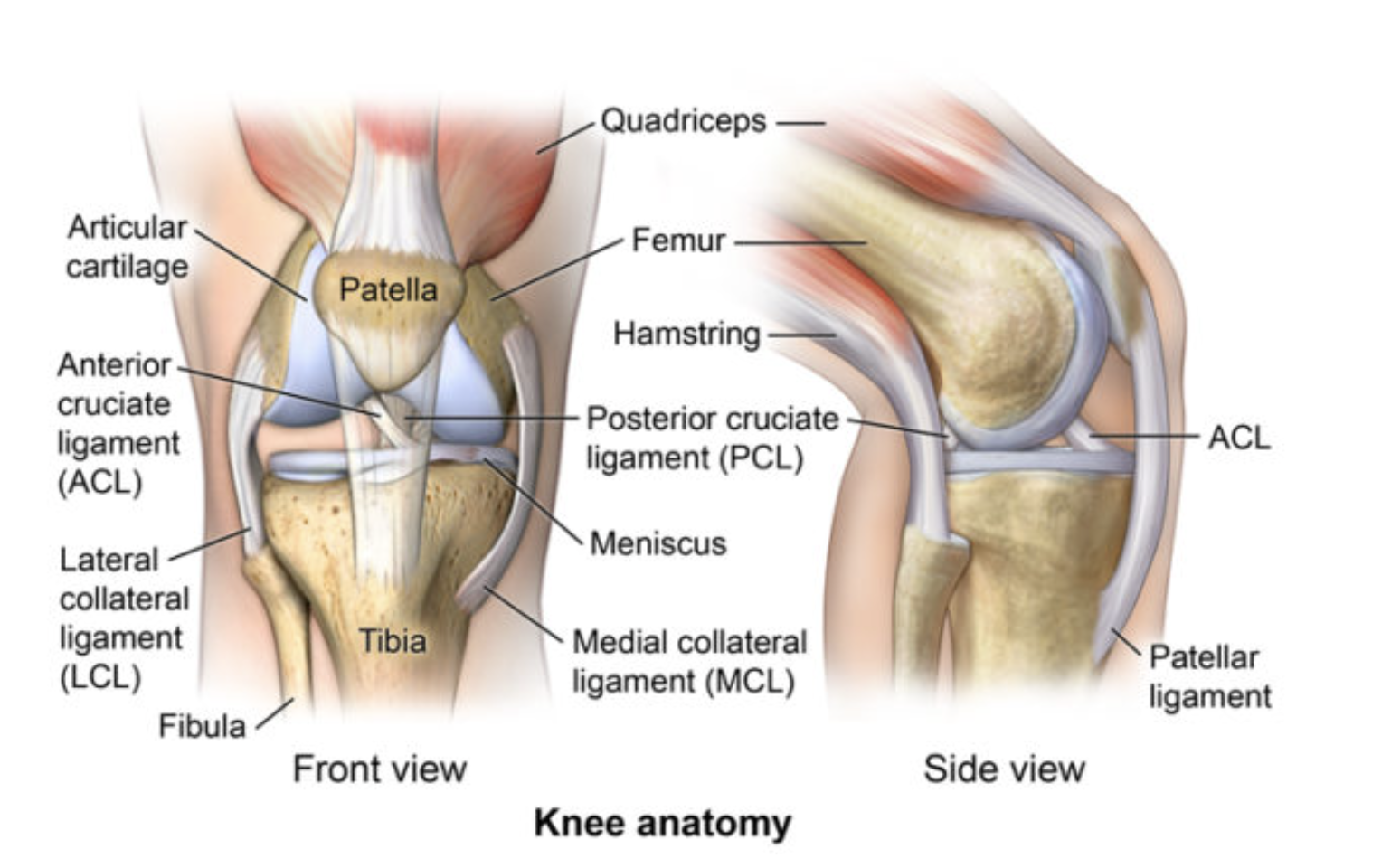
The knee is essentially a hinge joint formed where your femur, tibia, and patella (kneecap) meet. Two curved pieces of cartilage called the menisci sit between the femur and tibia, acting as shock absorbers and helping distribute load evenly across the joint. Four main ligaments — the ACL and PCL running through the centre of the joint, and the MCL and LCL on either side — provide stability, controlling how far the knee can bend, straighten, and rotate. The patella sits within the quadriceps tendon at the front of the knee, gliding within a groove on the femur as you bend and straighten your leg. Below it, the patellar tendon connects the kneecap to the shin bone and takes on enormous load with running, jumping, and squatting. On the outside of the knee, the iliotibial band, a thick band of connective tissue running from the hip down the outside of the thigh, crosses the joint and can become a source of pain in its own right, particularly in runners
Knee Physiotherapy Erina & Central Coast
Common Knee Conditions We Treat
Knee pain can come from several different structures, and it's common for more than one to be contributing at once. Here are six of the conditions we see most often at our Erina clinic.
Patellofemoral Pain Syndrome (Runner's Knee)
One of the most common causes of anterior knee pain, particularly in runners, gym-goers, and active teenagers. It involves irritation around the kneecap, often related to how the patella is tracking within its groove as the knee bends and straightens, sometimes influenced by hip and quad strength further up the chain. It typically causes an ache around or behind the kneecap that's worse with squatting, stairs, running, or sitting with the knee bent for long periods, such as at the movies or on a long flight, sometimes referred to as ‘theatre sign’.
Learn more: Patellofemoral Pain Syndrome (Runner's Knee) →
Patellar Tendinopathy (Jumper's Knee)
An overload injury to the patellar tendon, which connects the kneecap to the shin bone, common in sports involving a lot of jumping and landing, such as basketball, volleyball, and netball. It causes pain directly at the bottom of the kneecap that's typically worse with jumping, squatting, and going down stairs, and tends to warm up during activity before returning, often worse the following morning — a pattern very typical of tendon overload rather than a sign of structural damage that won't recover.
Learn more: Patellar Tendinopathy (Jumper's Knee) →
Knee Osteoarthritis
A gradual wearing of the cartilage within the knee joint, most common in people over 50 and often more noticeable after activity or in cold weather. It typically causes a deep ache, stiffness, and sometimes a grinding or catching sensation with movement, along with gradually reduced walking tolerance and difficulty with stairs. While it can't be reversed, the right management makes a genuine difference to pain, stiffness, and day-to-day function, and most people manage it well long-term without needing surgery.
Learn more: Knee Osteoarthritis →
ACL Injury
The anterior cruciate ligament is one of the main stabilising ligaments in the knee, commonly injured during sports involving sudden changes of direction, pivoting, or landing awkwardly from a jump. It's often accompanied by a distinctive pop and rapid swelling, and can range from a partial sprain through to a complete tear, with management depending heavily on the individual's activity goals, associated injuries to the meniscus or other ligaments, and how the knee responds to a structured pre-surgical or conservative rehabilitation program.
Learn more: ACL Injury →
Meniscus Tear
The meniscus can tear either traumatically, from a twisting injury during sport, or degeneratively, from gradual wear over time without any single specific incident, which is actually the more common presentation in patients over 40. It typically causes pain along the joint line, sometimes with catching, locking, or a sensation of the knee giving way, and the right management approach differs considerably depending on which type of tear you're dealing with and where within the meniscus it's located.
Learn more: Meniscus Tear →
Iliotibial Band Syndrome (ITB Syndrome)
A common overuse injury in runners and cyclists, where the iliotibial band becomes irritated as it crosses the outside of the knee. It typically causes a sharp or burning pain on the outer knee that comes on after a predictable distance or time into a run, and tends to ease with rest, only to return again once training resumes at the same level. Hip strength and control, along with training factors like a sudden increase in downhill running, are common underlying contributors.
Learn more: Iliotibial Band Syndrome (ITB Syndrome) →
Common Knee Symptoms
People describe knee pain in all sorts of ways, and the specific location and pattern of symptoms often tells us a lot before we've even begun the physical assessment. It's rarely just ‘my knee hurts’ — it's usually a fairly specific combination of the following:
An ache around or behind the kneecap, worse with stairs or squatting
Pain directly at the bottom of the kneecap, worse with jumping or landing
A deep ache and stiffness within the joint, particularly in the morning
Swelling that developed rapidly after a twisting or landing injury
Pain along the joint line, with catching, locking, or giving way
A sharp or burning pain on the outside of the knee during running
A popping or clicking sensation with bending and straightening
Pain that started after a specific injury, or built up gradually with training
A feeling that the knee is unstable or might give way under load
You don't need to know exactly which structure is involved before booking in — that's exactly what your assessment is for. But if any of the above sounds familiar, particularly if there's significant swelling, locking, or a feeling of instability, it's worth getting a proper assessment rather than just waiting to see what happens.
The knee is also heavily influenced by what's happening above and below it — hip strength and control plays a significant role in how load is distributed through the knee, and foot and ankle mechanics can similarly change how forces travel up through the leg. This is part of why a thorough knee assessment often looks well beyond the knee itself, and why two people with what looks like the same knee injury can sometimes need quite different rehab programs depending on what's happening at the hip or foot.
It's worth saying clearly: the knee is built to handle a genuinely large amount of repetitive load, absorbing several times your body weight with every stride when running. Persistent pain doesn't usually mean something fragile or damaged beyond repair — far more often it reflects a system that's become sensitised, deconditioned, or simply hasn't had the right rehab yet.
This distinction matters clinically as much as it matters for peace of mind. A knee that's sore because it's deconditioned and overloaded needs a very different approach to one with a genuine ligament tear, and part of our job in your first session is working out which situation you're actually in, rather than assuming the worst from a scan report or a friend's story about their own knee surgery.
How We Assess Knee Pain
Your first appointment starts with a thorough conversation about how your pain started, what your training, work, and daily activities actually involve, and what's been aggravating things. For injuries with a clear traumatic onset, we'll ask specifically about the mechanism of injury — which direction you were moving, whether you felt a pop, and how quickly any swelling appeared — since this often narrows down the likely structures involved considerably.
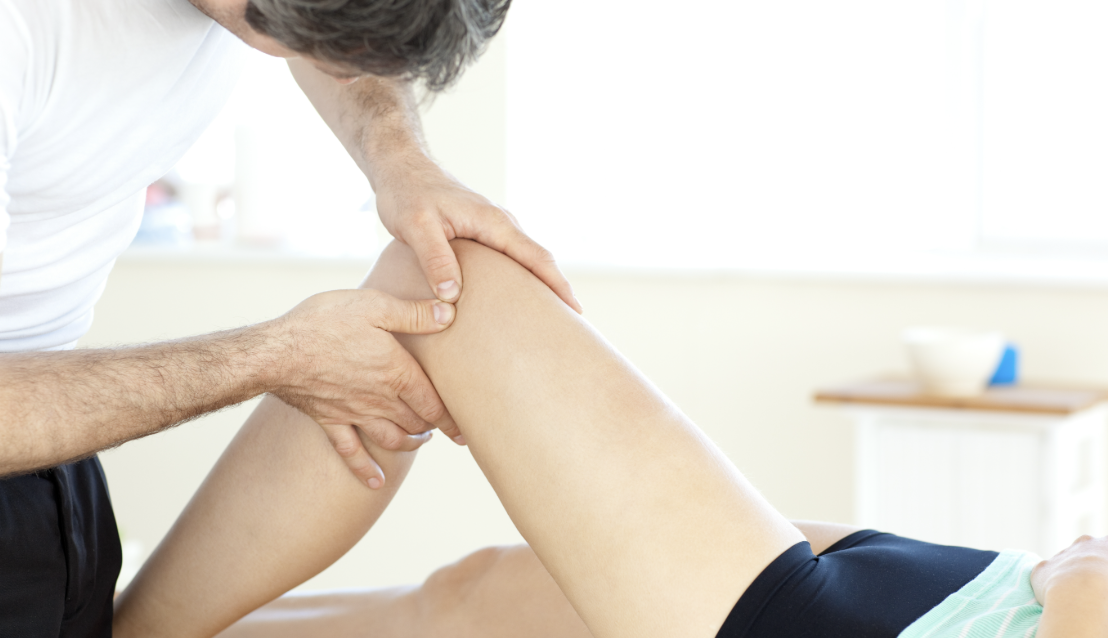
From there, we move into a hands-on assessment of your knee's movement, strength, and a series of specific tests that help pinpoint exactly which structure is involved — whether that's a ligament, the meniscus, a tendon, or the joint itself. We'll also assess your hip and ankle, since strength and control in these areas plays a significant role in how load is distributed through the knee, and addressing only the knee without looking at the whole leg can leave part of the problem untreated.
In most cases, imaging isn't required initially. A thorough clinical assessment identifies the likely cause in the large majority of presentations, and we reserve imaging for cases with suspected significant ligament or meniscus injury, cases that aren't progressing as expected, or where the findings would genuinely change the management plan. By the end of your first session, you'll have a working diagnosis, a clear explanation of what's driving your symptoms, and a first set of exercises or advice to start on straight away.
How Physiotherapy Helps
Treatment is built around what's actually driving your specific pain. For tendon and patellofemoral conditions, this usually means a progressive loading program designed to rebuild tissue tolerance, combined with addressing hip and ankle strength and control that's contributing to the overload. For osteoarthritis, treatment focuses on optimising strength and movement quality around the joint to reduce symptoms and improve function.
For ligament and meniscus injuries, we'll guide you through a structured, staged rehabilitation program that respects healing timeframes while progressively restoring strength, control, and confidence in the knee. For more significant injuries where surgery is being considered or has already occurred, we play a central role both before and after surgery, focused on protecting the knee, minimising muscle loss, and building the strength needed for a confident return to activity.
None of this is a quick, one-session fix. Knee ligaments, tendons, and joints in particular need time and consistent loading to rebuild capacity and confidence, and rushing this process is one of the most common reasons knee problems become recurring issues rather than something that resolves properly. We'll be upfront with you about roughly how many sessions we expect you'll need and what progress should look like along the way.
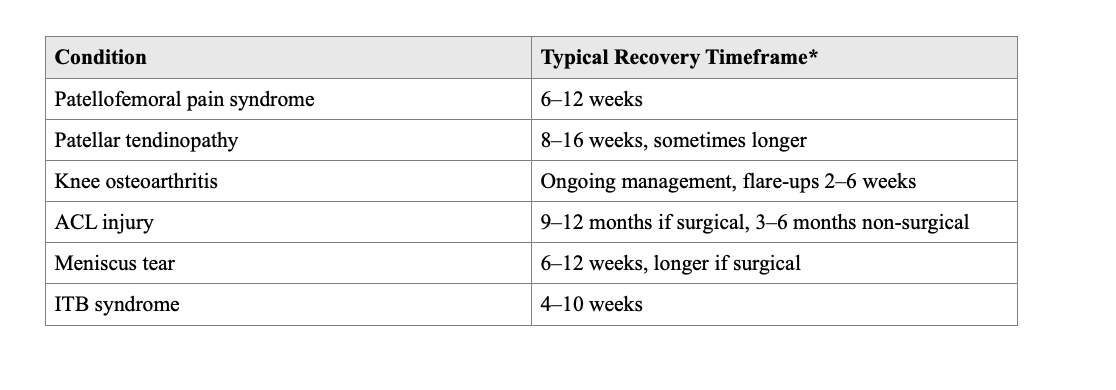
Knee Recovery Timeframes
Every knee is different, but these general ranges give you a rough idea of what to expect. Your physiotherapist will give you a more accurate timeframe once we understand your specific diagnosis.
Preventing Knee Pain From Coming Back
Once your knee has settled, the priority shifts to keeping it that way. Ongoing strength through the hip, quads, and calf is one of the best-supported ways to reduce the risk of a repeat flare-up, along with sensible pacing of any increases in running, training, or activity volume.
For runners and sportspeople, gradual, well-planned progressions in training load — rather than sudden jumps in distance, intensity, or a new activity altogether — make a genuine difference to how resilient your knee stays over time. For older patients managing osteoarthritis, staying consistently active with an appropriate maintenance program tends to matter more for long-term function than any single treatment.
We'll talk you through exactly what an ongoing maintenance plan looks like for your specific knee and lifestyle before you finish your course of treatment, so you're not left guessing about what to keep doing once regular sessions wrap up.
Why Choose Thrive Physiotherapy
We're a local team based right here in Erina, and knee pain is one of the conditions we treat most often — from runners and weekend sportspeople to older patients wanting to stay active and independent. We take the time to explain what's actually going on with your knee in plain language and build a plan around your goals, not a generic handout.
Whether your knee pain is brand new or something you've been managing around for years, our approach stays the same: a proper assessment, an honest explanation, and a plan that's realistic for your life — not just an idealised version of it. If something isn't improving the way we expected, we'll say so and adjust the plan rather than quietly continuing on regardless.
We also keep a close eye on the things that get missed elsewhere — how your hip and ankle are moving, whether your glutes and quads are doing their share of the work, and whether pain has started to change how you're walking or training more broadly. Knees rarely operate in isolation, and treating the whole picture is usually what separates a quick fix from a lasting one.
Frequently Asked Questions
Do I need a referral to see a physiotherapist for knee pain?
No, you can book directly with us. If you're being treated under a specific plan such as an EPC or WorkCover claim, bring any paperwork along and we'll help you sort out the details.
Will I need a scan for my knee pain?
Usually not initially. Most knee conditions can be diagnosed clinically, and imaging is reserved for cases with suspected significant ligament or meniscus injury, or where recovery isn't progressing as expected.
I've torn my ACL — do I definitely need surgery?
Not necessarily. Management depends on your age, activity goals, associated injuries, and how your knee responds to a structured rehabilitation program. Many people manage well without surgery, while others, particularly those returning to pivoting sports, benefit from surgical reconstruction.
Can I keep running or playing sport while my knee heals?
In most cases, yes, with some modification. We'll help you identify which specific movements or volume to adjust rather than telling you to stop everything.
How many sessions will I need?
It depends entirely on the condition and how long it's been going on. Some knees settle in a handful of sessions; others, particularly ligament, meniscus, or longer-standing tendon issues, need a longer-term plan. We'll give you an honest estimate after your first visit.
Is it bad to keep exercising with knee pain?
In most cases, no — appropriate, modified exercise is generally well tolerated and helpful, though we'll help you identify if a specific movement or volume needs temporary adjustment.
Why does my knee click or pop when I move it?
Clicking or popping without pain or swelling is very common and usually not a sign of damage. It becomes more relevant clinically when it's accompanied by pain, catching, or a feeling of instability.
What if my knee pain has been going on for months, or even years?
That's still very treatable. Long-standing knee pain often responds well once the right diagnosis and loading plan are in place, though it may take a bit longer to settle than a recent injury.
Book Your Knee Assessment
If knee pain is affecting your training, your work, or the activities you enjoy, don't wait for it to get worse. The longer it's left, the more it tends to affect strength and confidence in movement, which can make recovery slower than it needed to be.
Book an appointment with our Erina team and let's work out exactly what's going on — and what to do about it. Most people are relieved to finally have a clear explanation, rather than continuing to guess at what's wrong and hoping it settles on its own.