

Hip Impingement (FAI) & Labral Tear Physiotherapy — Erina & Central Coast
Deep groin pain with squatting, sitting for long periods, or twisting movements, sometimes with a catching or clicking sensation, is a common presentation of hip impingement, also known as femoroacetabular impingement or FAI. It's a condition we see often in younger, active patients, and one that generally responds well to the right rehab approach.
What Is Hip Impingement?
FAI occurs when extra bone develops on the femoral head, the socket, or both, causing repeated pinching between the ball and socket during certain hip movements, particularly deep flexion and rotation. Over time, this repeated impingement can irritate or tear the labrum, the ring of cartilage that lines the hip socket and helps create a secure seal around the joint.
It's worth knowing that the bony shape associated with FAI is relatively common in the general population, including in many people with no pain at all. What matters clinically is whether that shape, combined with your movement patterns and activity demands, is actually producing symptoms — which is exactly what a thorough assessment helps clarify.
It's also worth noting that FAI and labral tears often coexist with other contributing factors, such as reduced hip and pelvic control, so treating the whole movement picture rather than fixating solely on the bony shape or the labrum itself tends to produce better, more lasting results.
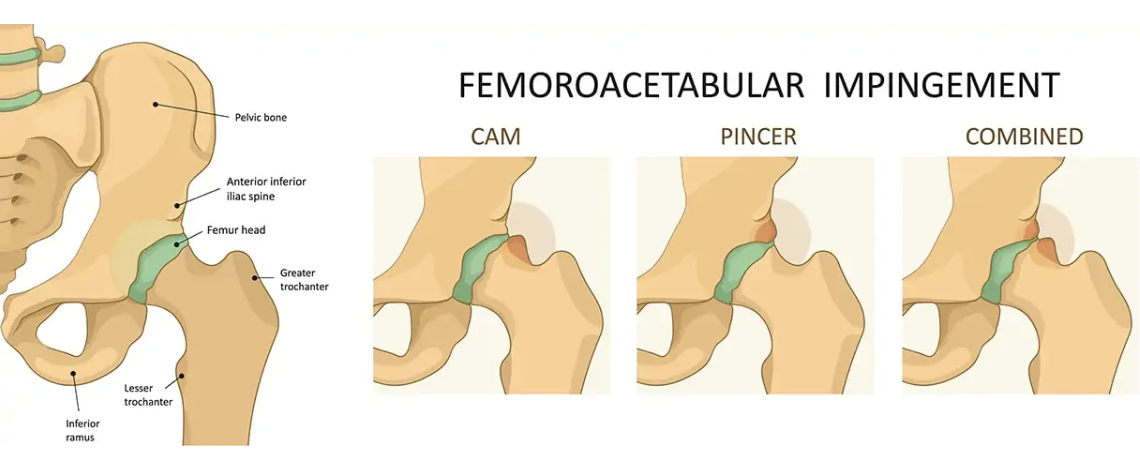
What Causes It?
FAI is more common in people involved in sports requiring repetitive deep hip flexion and rotation — football, hockey, martial arts, and dancing are common examples. Some degree of the underlying bony shape may also be present from adolescence, developing during a period of bone growth, and becomes symptomatic later when activity demands increase.
Common Symptoms
Deep groin pain, often described as a ‘C-sign’ grasp around the front and side of the hip
Pain with sitting for long periods, particularly in low chairs
Discomfort with squatting, twisting, or pivoting movements
A catching, clicking, or locking sensation in the hip
Pain that worsens with prolonged or deep hip flexion, such as getting in and out of a car
How We Diagnose It
Assessment includes specific movement and provocation tests that reproduce symptoms by combining hip flexion with rotation, along with an evaluation of your hip and pelvic strength and control more broadly. Imaging, typically an X-ray and sometimes an MRI, can help confirm the bony shape and assess the labrum, particularly if symptoms are significant or not responding to initial conservative management.
How Physiotherapy Helps
Treatment focuses on optimising the strength and movement quality around the hip and pelvis, which can meaningfully reduce symptoms even though the underlying bony shape itself doesn't change. This includes targeted strengthening of the deep hip stabilisers and glutes, along with movement retraining to reduce unnecessary compressive loading during squatting, pivoting, and deep flexion activities.
Many people with FAI and even confirmed labral tears do well with a structured, well-run physiotherapy program and never need surgery. For cases that don't respond adequately to conservative management, or where symptoms are significantly limiting sport or daily function, we'll discuss a specialist opinion regarding surgical options, and continue to play a role in both pre-surgical preparation and post-surgical rehabilitation if that's the path you take.
Self-Care While You Wait For Your Appointment
Avoiding very deep squatting and prolonged sitting in low chairs, where possible, can help reduce symptoms in the short term. Gentle movement within a comfortable range is generally fine and helpful, while sudden pivoting or twisting movements are worth minimising until you've had a proper assessment.
Frequently Asked Questions
Does FAI always need surgery?
No, many cases are managed successfully with physiotherapy alone. Surgery is generally considered when conservative management hasn't adequately improved symptoms or function.
Can I still play sport with hip impingement?
Often yes, with some modification to technique and training load. We'll help you find a sustainable way to keep training while managing your symptoms.
Will a labral tear get worse over time?
Not necessarily. Many labral tears remain stable for years with appropriate management, and the presence of a tear on imaging doesn't automatically mean it will progress or require surgery.
Book a Hip Assessment in Erina
If hip impingement or a labral tear is getting in the way of walking, sport or everyday life, the sooner it's properly assessed, the sooner we can get you moving with confidence again. Our Erina team will give you a clear diagnosis, an honest treatment plan, and a realistic timeframe — no guesswork, no generic exercise sheets.
Call Thrive Physiotherapy or book online today to get started.
Not sure if this is what's causing your hip pain? Visit our Hip Physiotherapy hub page to see the full range of hip conditions we treat.