

High Ankle Sprain Physiotherapy — Erina & Central Coast
Pain higher up the ankle than a typical rolled ankle, often following a forceful twisting injury during contact sport, can point to a high ankle sprain, also known as a syndesmosis injury. It's a less common but generally more significant injury than a standard lateral ankle sprain, and it's important to recognise early since the recovery timeframe and management approach differ meaningfully.
What Is a High Ankle Sprain?
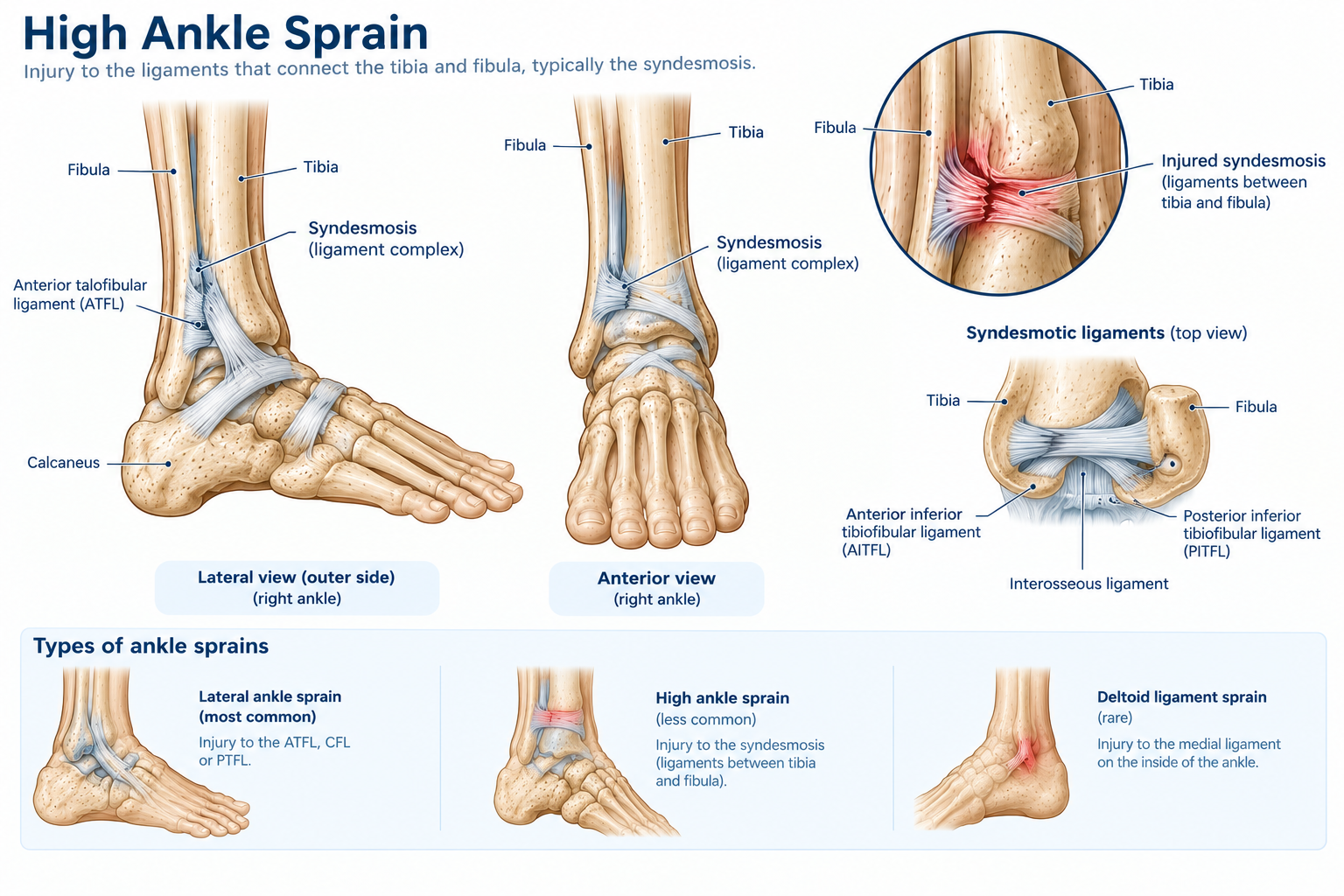
The syndesmosis is a strong set of ligaments binding the tibia and fibula together just above the ankle joint, providing crucial stability to the whole ankle mortise, the socket-like structure the talus sits within. A high ankle sprain involves injury to these ligaments, typically from a forceful outward rotation or twisting injury, and can range from a partial sprain through to a complete disruption requiring surgical stabilisation.
What Causes It?
High ankle sprains commonly occur in contact and collision sports — football, rugby, and similar sports where the foot can become fixed on the ground while the body rotates over it, often during a tackle. They're less commonly caused by the simple inward-rolling mechanism behind most standard ankle sprains, which is part of why the injury mechanism itself is an important clue during assessment.
Common Symptoms
Pain higher up the ankle, above the typical area for a standard sprain
Pain that worsens with any rotational movement of the ankle or lower leg
Difficulty or significant pain with weight-bearing
Pain with squeezing the shin bones together above the ankle
A sense that the injury feels more significant than a typical rolled ankle
How We Diagnose It
Assessment includes specific tests that stress the syndesmosis directly, along with an evaluation of your ability to weight-bear and overall ankle stability. Because syndesmosis injuries can involve significant instability and sometimes accompanying fractures, imaging — typically an X-ray, and sometimes an MRI for more subtle injuries — is often recommended, and we'll organise this promptly along with a specialist referral if the injury appears more significant.
How Physiotherapy Helps
Management depends heavily on the severity of the injury. Milder sprains without significant instability are managed with a staged rehabilitation program similar in principle to a standard ankle sprain, but generally over a longer timeframe given the importance of this ligament complex to overall ankle stability. More significant injuries with instability often require a period of surgical stabilisation, after which physiotherapy plays a central role in the structured rehabilitation process.
Whichever pathway is appropriate for your injury, rushing the return to sport or demanding activity is a significant risk factor for ongoing problems, given how central the syndesmosis is to overall ankle function. We'll use clear, objective milestones to guide your return to sport, rather than just a fixed timeframe.
Self-Care While You Wait For Your Appointment
Given the potentially more significant nature of this injury, protecting the ankle, avoiding weight-bearing if it's significantly painful, and using crutches if needed will help in the short term. Prompt assessment is particularly important for this injury given the possibility of associated instability or fracture, so we'd encourage booking in as soon as possible after a suspected high ankle sprain.
Frequently Asked Questions
How is a high ankle sprain different from a regular ankle sprain?
A high ankle sprain involves the ligaments above the ankle joint rather than the more commonly injured ligaments on the outside of the ankle, and generally takes considerably longer to recover, with a higher likelihood of needing imaging and specialist input.
Will I need surgery for a high ankle sprain?
Not always. Milder injuries without significant instability are often managed conservatively, while more significant injuries with instability may require surgical stabilisation. This is generally guided by a specialist opinion alongside your imaging findings.
How long until I can return to sport?
This varies considerably with severity, from around six weeks for milder injuries to three months or more for more significant or surgically managed injuries. We'll track your progress against clear milestones rather than a fixed calendar date.
Book an Ankle & Foot Assessment in Erina
If a high ankle sprain is getting in the way of walking, training or work, the sooner it's properly assessed, the sooner we can get you moving with confidence again. Our Erina team will give you a clear diagnosis, an honest treatment plan, and a realistic timeframe — no guesswork, no generic exercise sheets.
Call Thrive Physiotherapy or book online today to get started.
Not sure if this is what's causing your ankle or foot pain? Visit our Ankle & Foot Physiotherapy hub page to see the full range of conditions we treat.